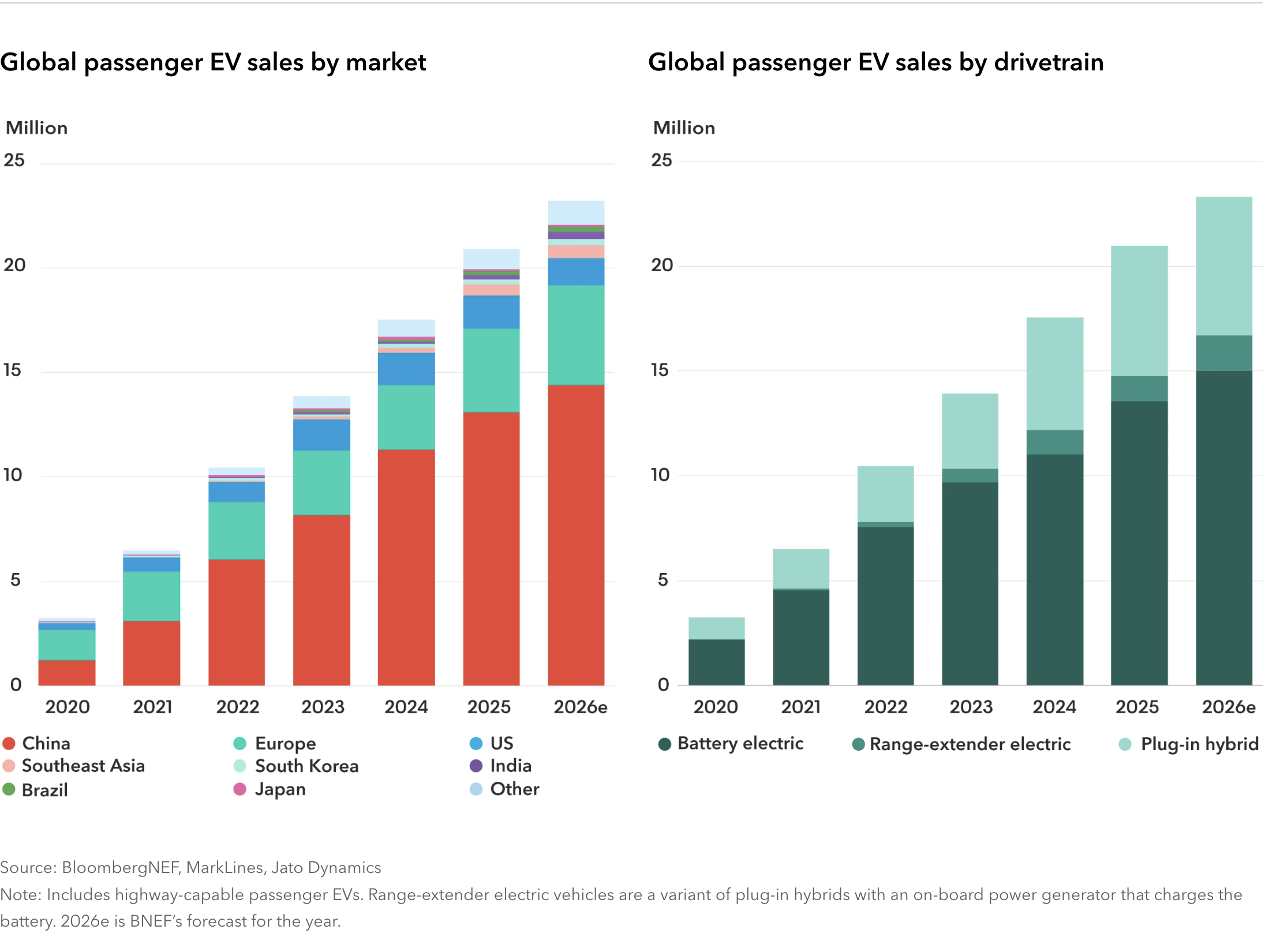
Electrification of road transport is accelerating unevenly, and for the second consecutive year BloombergNEF has cut its EV adoption outlook, citing the full withdrawal of U.S. federal support alongside a maturing Chinese market and rising trade tensions. VX News here excerpts the executive summary of BNEF’s 2026 Electric Vehicle Outlook, which projects EVs will reach 27% of global passenger vehicle sales this year and examines how upfront prices and battery costs can fall further. Find full report here.
Executive summary
Electric vehicles are still in their adolescence. Growth is uneven, with some markets accelerating at a rapid rate, while others have slowed to a near stall. Globally, electric vehicles are still on track for another record-breaking year, driven by falling lithium-ion battery prices, the introduction of more affordable models and a surge of EV interest in emerging markets, often buoyed by their openness to competitively priced models from Chinese automakers. Electric vehicles – batteryelectric and plug-in hybrid vehicles combined – are set to account for 27% of all passenger vehicles sold globally this year, a remarkable increase from just six years ago when EVs represented under 5% of global new vehicle sales. Nearly 60% of the 2026 global car market is set to be in countries where the electric vehicle share of new car sales has passed the 10% mark, often regarded as an inflection point at which organic consumer demand overtakes policy as the main adoption driver.
The Iran war and the resulting increase in prices at the pump has boosted consumer interest in buying an electric vehicle, which could translate into higher EV sales over the near-term if the conflict keeps pump prices high long enough. But new electric vehicles are still more expensive to buy and own than comparable internal combustion engine vehicles in many markets, as automakers balance higher drivetrain costs, return on investment and market pricing strategies aimed at preserving margins.
However, there is scope for battery-electric vehicle prices to fall further, with affordable batteries essential to achieving these reductions. In most markets apart from China, lithium-ion batteries still remain too costly, despite significant price reductions recorded in BNEF’s survey since 2010. China’s cost advantage stems from numerous factors, spanning a mature supply chain to favorable financing conditions. This 2026 report delves deeper into the upfront prices and total cost of ownership for EVs, focusing on how both can be reduced. It also unpacks China’s battery advantage and how other markets are catching up.
Road transport electrification is quickly spreading beyond passenger cars. Electric commercial vehicles are now a million-unit market, but the next phase of growth shows divergence, with electric vans scaling across more markets while trucks remain concentrated in China. At the same time, more than half of city bus sales in 20 global markets are now electric, while electric twowheelers, including scooters, motorcycles, and mopeds, continue to gain share in markets such as China, India and Vietnam. The use of shared mobility is also rising, and autonomous-vehicle services have been successfully commercialized in several cities.
This is the second consecutive year where we have reduced both our near-term and long-term passenger EV adoption outlook. Full withdrawal of federal regulatory support for electrification in the US is the biggest factor, with national fuel-economy targets rolled back, the end of supportive elements of the Inflation Reduction Act, and the removal of California’s ability to set its own airquality standards. A slowdown in China also plays a role this year, as the market matures rapidly and competition intensifies. Rising trade tensions and increased tariffs continue to shake up decades of closer integration across global automotive markets. The Iran war has the potential to impact EV sales in numerous ways, most clearly by making EVs more attractive relative to internal combustion vehicles through increased oil prices. However, the conflict could also raise friction in the automotive supply chain and force changes in inflation and interest rates that will impact consumer interest in purchasing new vehicles.
Against this increasingly complex backdrop, we are proud to present our 2026 Electric Vehicle Outlook, which examines each of the trends outlined above. The report also provides two updated scenarios for the future of road transport, drawing on BNEF's team of sectoral and regional experts around the world.
Our Economic Transition Scenario is the main scenario described in this report. It assumes no new policies or regulations are enacted that impact the market. It also does not assume any longterm climate targets are met, or that any combustion vehicle phase-out targets that have been announced by countries, states, cities or companies are achieved. Instead, adoption is primarily driven by techno-economic trends and market forces. The Net Zero Scenario investigates what a potential route to net-zero emissions by 2050 might look like for the road transport sector. It looks primarily at economics as the deciding factor for which drivetrain technologies are implemented to reach the 2050 target.
This report includes analysis of EV adoption in passenger vehicles, commercial vans and trucks, two- and three-wheeled vehicles, and buses globally. It also looks at other drivetrains, including hybrids, natural gas and fuel cells, and explores the resulting impacts on demand for electricity, oil, batteries and materials, as well as CO2 emissions.