
VX Excerpt: National Academies of Science, Engineering, and Medicine Attributes Extreme Weather and Climate Events & Their Impacts to Human Caused Climate Change
As extreme weather grows more frequent and costly, the scientific ability to link a specific heat wave, flood, or drought to human-caused climate change has become central to how governments, insurers, and courts assess responsibility and risk. VX News here excerpts Attribution of Extreme Weather and Climate Events and Their Impacts, the National Academies of Sciences, Engineering, and Medicine's 2026 consensus study, chaired by James W. Hurrell of Colorado State University, which updates the Academies' 2016 assessment of extreme event attribution (EEA) science and extends the analysis into the emerging field of extreme event impact attribution (EEIA) — evaluating how much climate change shapes not just an event's physical severity, but its human and economic toll.
“The committee finds that the scientific foundation for EEA has strengthened markedly over the past decade, as accumulating observational and modeling evidence has borne out long-standing theoretical expectations about how a warming atmosphere behaves.” — (National Academies of Sciences, Engineering, and Medicine, 2026)
Preface
A committee of experts convened by the National Academies of Science, Engineering, and Medicine spent 18 months examining the state of Extreme Event Attribution (EEA) science at what it describes as a moment of accelerating climate impacts and heightened public attention to the field. The study builds directly on the Academies' 2016 assessment, which captured EEA science when it was still an emerging field; the committee frames the years since as a period in which the field matured considerably, propelled by better modeling, richer observational data, and rising demand for fast, event-specific answers. At the same time, the growing frequency and severity of extreme events have sharpened scrutiny of exactly what attribution science can and cannot reliably claim.
The committee is explicit that the report is meant to function as a synthesis of current scientific understanding and a guide to best practices – not as a prescription for how attribution findings should be applied in any specific policy or legal context. In his closing acknowledgments, Chair Hurrell, Chair of the Committee, credits the committee's cross-disciplinary composition – spanning climate dynamics, statistics, impacts, and risk analysis – along with the contributions of outside experts and stakeholders who took part in the committee's public information-gathering sessions, and Study Director Stephanie Johnson for steering the effort to completion.
Executive Summary
The committee finds that the scientific foundation for EEA has strengthened markedly over the past decade, as accumulating observational and modeling evidence has borne out long-standing theoretical expectations about how a warming atmosphere behaves. More sophisticated numerical models, larger observational datasets, and the application of advanced statistical and machine-learning techniques have together produced more robust assessments across a broader range of extreme event types. Two developments stand out: the spread of multi-method frameworks that cross-check findings using more than one analytical approach, and the operationalization of attribution science itself – organizations now routinely produce rapid attribution assessments within days of an event. The field has also expanded into EEIA, attributing real-world consequences such as health and economic impacts rather than just an event's physical magnitude, with findings from both EEA and EEIA increasingly informing practice.
That progress is uneven across event types. The committee's confidence is highest for extreme heat and cold and for large-scale heavy-rainfall events; phenomena with a direct, well-understood link to atmospheric warming. Confidence drops sharply for events driven by small-scale, fast-evolving dynamics that global climate models still struggle to resolve, such as severe convective storms, along with events in regions where long-term observational records are sparse. Compounding, cascading, and record-breaking events pose their own distinct methodological challenges, since the physical processes that drive them are still only partly understood.
To close these gaps, the committee calls for reducing systematic model biases, improving how climate models represent key physical processes and feedbacks, advancing high-resolution modeling, and developing hybrid EEA approaches that combine methods. It also recommends targeted international investment to fill spatial and temporal gaps in observational data, incorporate nontraditional data sources, build out impact-response functions, and strengthen EEA/EEIA capacity in underrepresented regions through improved data, model guides, and training. Across both fields, the committee argues that common methodological frameworks and transparent, consistent uncertainty quantification would make results easier to compare across studies, build public trust, and better meet the needs of decision-makers.
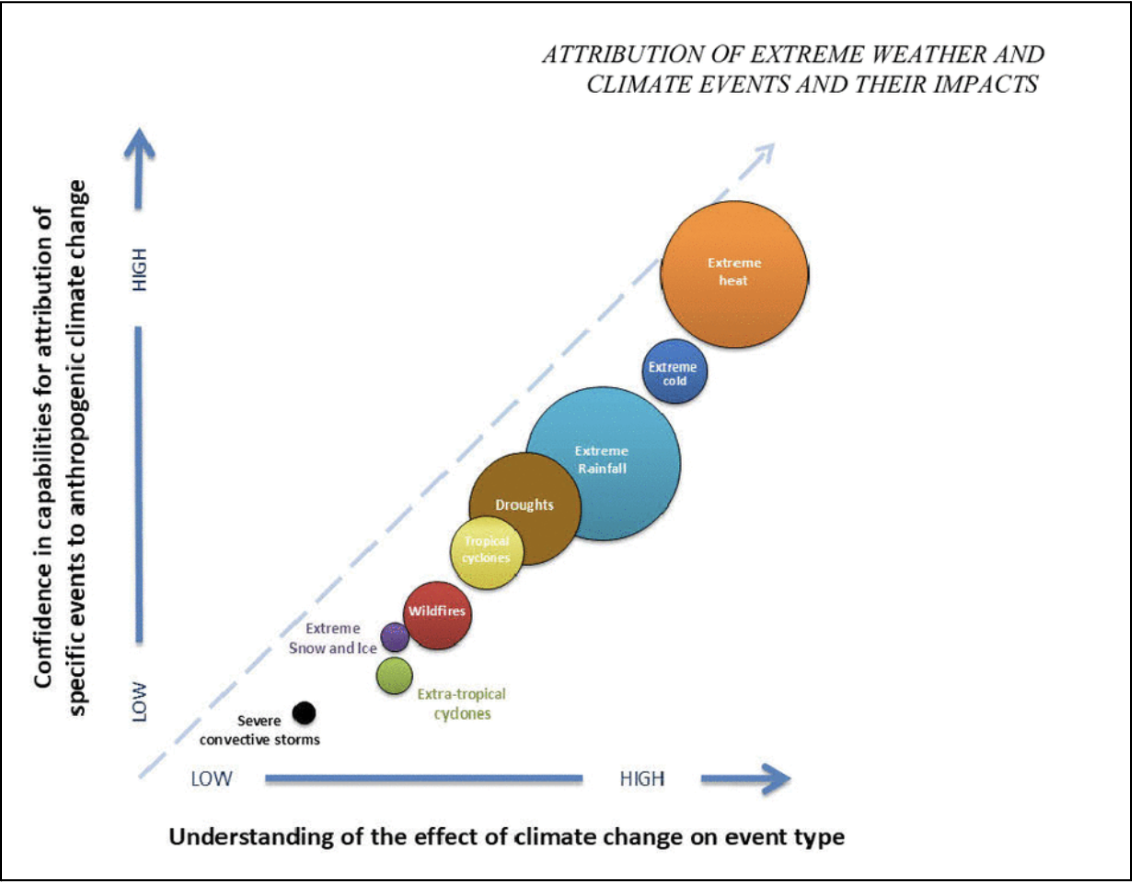
ATTRIBUTION OF EXTREME WEATHER AND CLIMATE EVENTS AND THEIR IMPACTS, Figure S-1
The Reports graphic, Figure S-1, plots each extreme-event category on two axes – the committee's confidence in attributing specific events to climate change, and the field's overall understanding of how climate change affects that event type – with bubble size scaled to the number of published studies. Extreme heat sits furthest along both axes, followed by extreme cold and large-scale heavy rainfall; droughts, tropical cyclones, and wildfires cluster in the middle; extreme snow/ice and extra-tropical cyclones trail further back; and severe convective storms sit at the low end of both scales. Every category falls below the 1:1 line, which the committee reads as headroom for improvement across the board – in modeling, observational record, and physical understanding – even for the best-understood event types.
This excerpt has been condensed and paraphrased by VX News from the original report published on July 15, 2026. For the report's full text, see nationalacademies.org/read/28590.
Source:
National Research Council. 2026. Attribution of Extreme Weather and Climate Events and Their Impacts.
Washington, DC: The National Academies Press. doi:10.17226/28590.
Tags: Climate Change, Attribution Science, Extreme Weather, Resilience, Risk Management
