
VX Feature: The Solar Stupidity is Blinding
Formerly the LA Times' first climate columnist and now writing independently on Climate-Colored Goggles, Sammy Roth argues that California regulators passed up an easy win on electricity affordability when they blocked PG&E's exit from the Ivanpah solar plant. In this piece, appearing originally on Climate-Colored Goggles and republished by VX News with permission, Roth weighs the CPUC's reliability rationale against contracts priced near $135 per megawatt-hour in a market building new solar for $38. Find the original, here.
The solar stupidity is blinding
California is determined to save the costly, controversial Ivanpah solar plant.
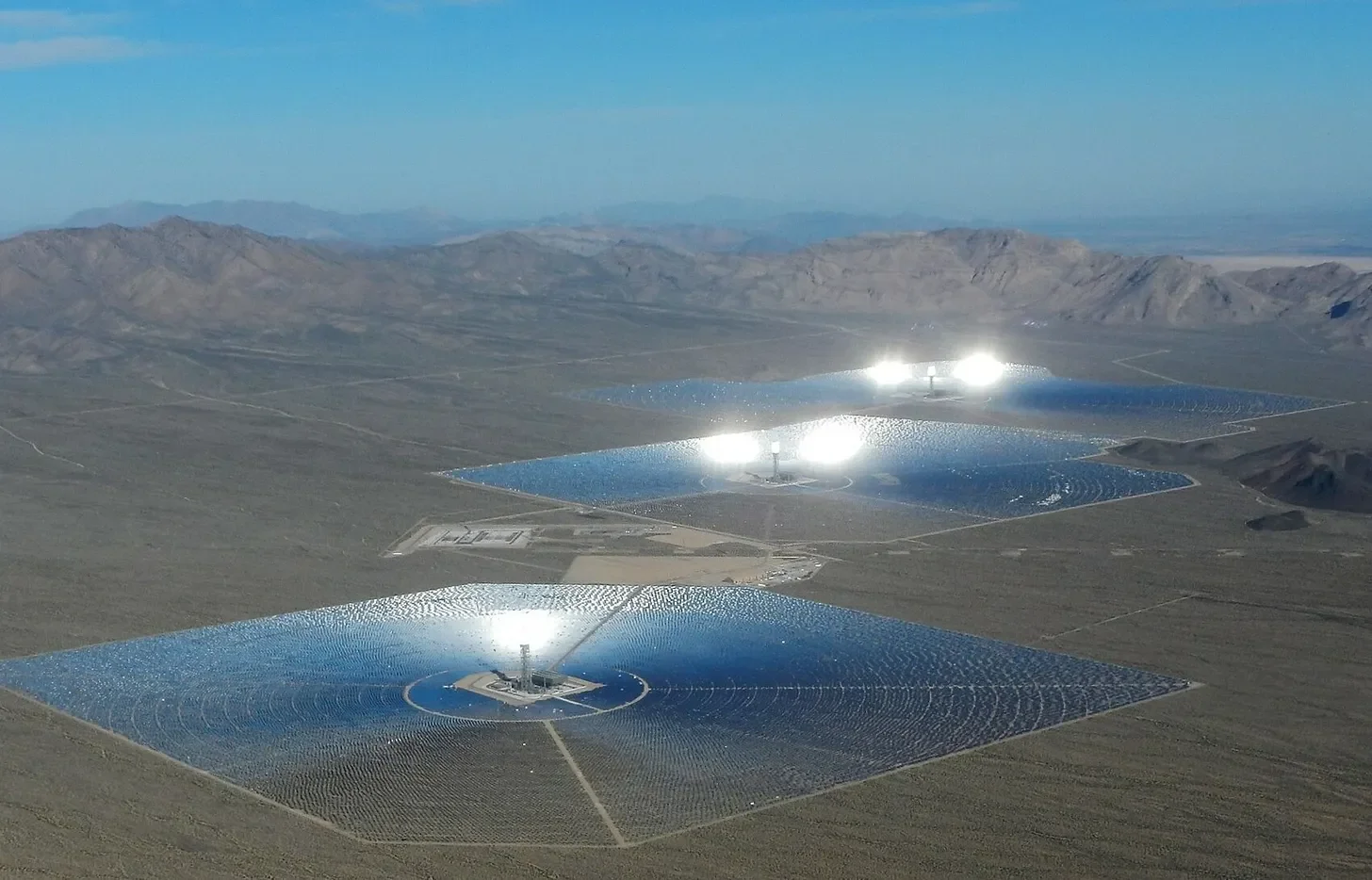
An aerial view of the Ivanpah solar project in California’s San Bernardino County. (Photo via U.S. Department of Energy)
During my dozen years writing about climate change, I can’t tell you how many times I’ve gotten annoyed by photos like the one above.
That’s the Ivanpah solar project, in the California desert not far from Las Vegas. It’s a clunky, aging facility that uses vast fields of mirrors to reflect sunlight toward the tops of giant towers, instead of dark flat panels that convert sunlight directly to electricity. It looks bizarre, to say the least — nothing like almost any other solar farm in the U.S. Many would call it ugly.
But it’s certainly eye-catching, which is why you’ll often see it featured in news stories about solar development — even when the stories aren’t about Ivanpah.
Which is a shame, because Ivanpah has become a poster child for anti solar crusaders. The technology hasn’t worked as well as once hoped, hence the shift to cheaper, more reliable solar panels. Ivanpah has also made international headlines for frying birds to death and distracting pilots with its blinding glare.
So when Pacific Gas & Electric announced this year that it had reached an agreement with Ivanpah’s owners to stop buying expensive power from the plant — allowing two of the three towers to shut down — I was pleasantly surprised.
PG&E said the contract cancellation would help keep utility bills down, an imperative in a state with some of the country’s most expensive energy. And maybe, just maybe, I would stop seeing so many misleading Ivanpah images.
Alas, the California Public Utilities Commission had other ideas.
On Thursday, Governor Gavin Newsom’s five appointees voted unanimously to reject the contract cancellation. There was no public discussion.
Wait, what?
The Public Utilities Commission laid out its rationale in a written decision. Basically, the commission ruled that even if PG&E customers might save money, canceling the Ivanpah contracts would be risky because electricity consumption is rising — thanks, AI! — and the Trump administration is working to block clean energy projects. Given those
trends, we can’t afford to lose any existing power sources. Doing so could invite power outages.
In theory, that makes sense. In practice, it may be an overreaction.
For one thing, Ivanpah produces a tiny amount of energy in the grand scheme of the California grid. For another, it’s not like the state has had trouble adding new energy resources to the grid. Since 2020 (the last time California suffered rolling blackouts), we’ve added tons of solar and battery storage. Trump is gumming up the works right now, especially on federal lands, but he can’t stop all new projects.
I sympathize with state officials wanting to play it safe — especially given the AI data center boom driving up expected electricity use.
But PG&E is similarly motivated to exercise caution, given the well deserved fury it would face from customers if it failed to keep the lights on. And PG&E isn’t worried about losing Ivanpah. In a comment letter, it politely dismantled the Public Utilities Commission’s rationale, describing it as “flawed” and “lacking.”
PG&E has good reason to ditch Ivanpah: The company is under tremendous pressure from lawmakers to reduce electric bills — and it’s paying insane prices for Ivanpah’s power. According to its comment letter, PG&E is paying $134 per megawatt-hour and $137 per megawatt hour for energy from the two towers. Those costs are passed along to PG&E customers (wit no profit for PG&E). For context, solar farms are getting built today for as little as $38 per megawatt-hour, according to the investment bank Lazard — even without the tax credits that Trump canceled.
Add battery storage, and prices still run as low as $50 per megawatt hour. Meaning it shouldn’t be hard to replace Ivanpah with much cheaper clean energy.
Anyway, not going to happen.
All things considered, shutting down Ivanpah wouldn’t have slashed PG&E bills by big amounts. And even if state officials had approved the contract termination, that might not have been the end of the story. Southern California Edison buys electricity from Ivanpah’s third tower, and Edison is still negotiating a possible exit. The PG&E deal was contingent on Edison getting approval for its own contract cancelation.
But there was an easy opportunity for a victory here.
A victory for electric bills, and also an aesthetic victory. When I started reporting on energy in 2014, I took an aerial tour of the desert — and the first thing I did afterward was write about Ivanpah. I was captivated, and how could I not be? I knew even then that the technology was
probably a loser. But those mirrors, those bright towers…they were so weird. So controversial. So mesmerizing.
It’s time for the sun to set on Ivanpah. Instead, AI is blowing up electricity demand. The Trump administration is attacking solar and wind. And California is responding by throwing Ivanpah a lifeline.
"The solar stupidity is blinding" appeared originally in Climate-Colored Goggles on December 4, 2025, and is republished by VX News with the author's permission. Sammy Roth writes Climate-Colored Goggles, a newsletter on climate and culture. Subscribe here.

_(cropped).jpg)